
Fine-Tuning vs. Prompt Engineering: Which One Do You Need?
Compare two ways to adapt an AI model to your task, and learn when each one actually pays off.
Two ways to change how a model behaves
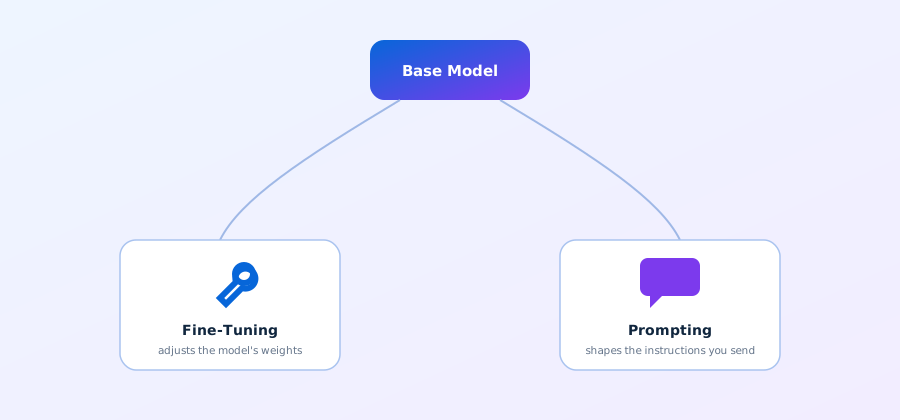
When a general-purpose AI model does not quite fit your task, you have two main options: change the model itself through fine-tuning, or change what you send it through prompt engineering. They solve similar problems in very different ways.
Prompt engineering: shaping the instructions
Prompt engineering means writing clearer instructions, adding examples, or restructuring your request so the base model produces better output without any retraining. It is fast to iterate, costs nothing beyond API calls, and can be adjusted per request.
System: You are a support agent. Answer in three short sentences,
and always end with a follow-up question.

User: My order hasn't arrived yet.
A well-designed prompt can dramatically improve results, especially with techniques like providing a few examples directly in the prompt (few-shot prompting) or asking the model to reason step by step before answering.
Fine-tuning: adjusting the weights
Fine-tuning trains the model further on examples specific to your task, permanently adjusting its internal weights. This is useful when you need a consistent style across thousands of requests, want to teach the model a narrow skill it doesn't do well out of the box, or need it to reliably follow a strict output format without repeating instructions every time.
The trade-offs
Prompting is cheap and reversible; a bad prompt just gets rewritten. Fine-tuning requires a labeled dataset, training time, and a way to host or serve the resulting model, but it can produce better and more consistent results for a narrow, well-defined task once that investment is made.
A practical rule of thumb
Start with prompt engineering. Add retrieval or examples if the model needs facts it doesn't already know. Only reach for fine-tuning once you have a stable, well-tested prompt and still see consistent gaps that better instructions cannot close.
Key takeaways
Prompting changes what you ask; fine-tuning changes what the model knows how to do. Most tasks are solved with careful prompting alone — fine-tuning is worth its cost only once you have proven that prompting has hit a ceiling.
Comments 0
Share your questions, experiences, or feedback about this article.
Sign in with Google to leave a comment.
Sign in with Google
No comments yet. Be the first to share your feedback.