Open-Weight vs. Closed AI Models: What's the Real Difference?
Llama and Mistral ship their weights; GPT and Claude stay behind an API. Here's what that trade-off means in practice.
Two different ways to distribute a model
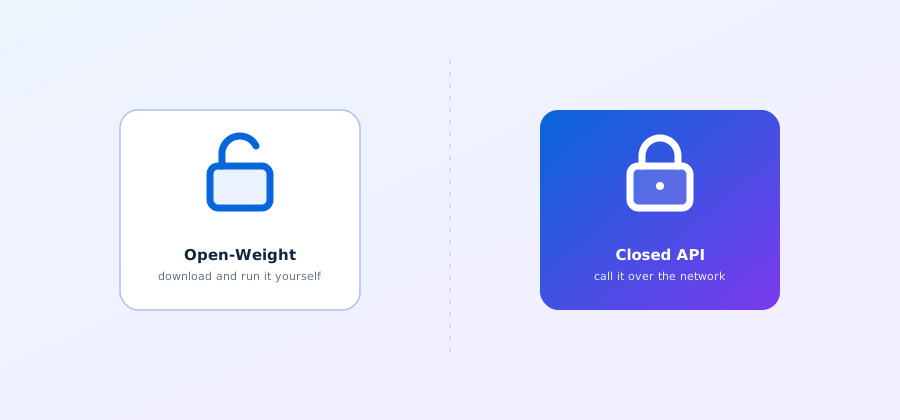
When people talk about "open source AI," they usually mean an open-weight model: one whose trained parameters you can download and run yourself, such as Llama or Mistral. A closed model, like GPT-4 or Claude, is only reachable through an API — you send a request and receive an answer, without ever touching the underlying weights.
What you gain with open weights
Running an open-weight model yourself means your data never has to leave your infrastructure, which matters for regulated or sensitive workloads. You can also fine-tune it freely, run it fully offline, and are never affected by a provider changing or discontinuing a model version you depend on.
What you gain with a closed API
Closed models are usually simpler to start with: no GPUs to provision, no model file to manage, and access to whichever model is currently the most capable, since providers continuously update them behind the same endpoint. For many teams, this operational simplicity outweighs the loss of control.
# Closed model: one HTTP call, no infrastructure to manage
response = client.chat(model="closed-model-name", messages=messages)

# Open-weight model: you own the serving stack
response = local_model.generate(messages, max_tokens=512)
"Open" is not always fully open
Licenses vary widely. Some open-weight models restrict commercial use above a certain number of users, others withhold the training data or code even though the weights are public. Always read the specific license before assuming an "open" model is free to use however you like.
Choosing between them
Pick open weights when data residency, offline access, or deep customization matter more than convenience. Pick a closed API when you want the strongest available model with minimal operational overhead, and your data-handling requirements allow sending requests to a third party.
Key takeaways
Open-weight models trade convenience for control; closed APIs trade control for convenience. Neither is universally better — the right choice depends on your data constraints, your engineering capacity, and how much customization your task really needs.
Comments 0
Share your questions, experiences, or feedback about this article.
Sign in with Google to leave a comment.
Sign in with Google
No comments yet. Be the first to share your feedback.