
Retrieval-Augmented Generation (RAG): Giving AI Models a Memory
Learn how RAG lets a language model answer questions using information it was never trained on.
The problem RAG solves
A language model only knows what was in its training data, frozen at whatever point training stopped. It cannot answer questions about your company's internal documents, yesterday's news, or anything published after its training cutoff — unless you give it that information directly. Retrieval-Augmented Generation, or RAG, is the standard technique for doing exactly that.
How the pipeline works
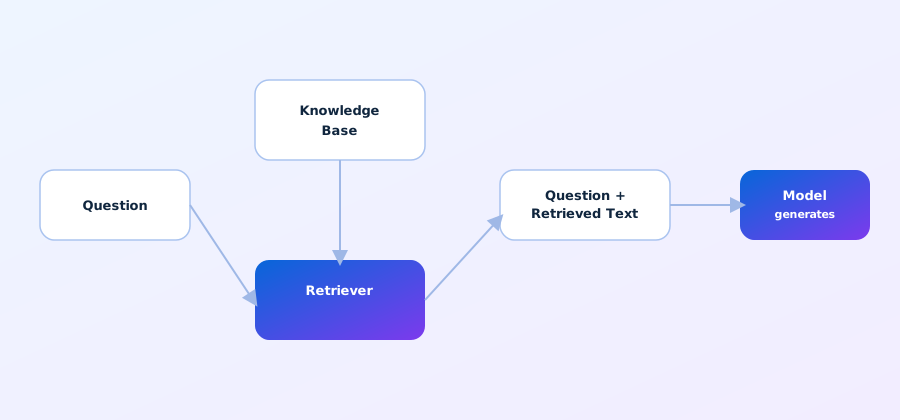
When a question comes in, the system first searches a knowledge base — a collection of documents converted into searchable vector embeddings — for the passages most relevant to that question. Those passages are then inserted into the prompt alongside the original question, and the model generates its answer using both.
question -> search(knowledge_base, question) -> relevant_chunks
prompt = f"Context:\n{relevant_chunks}\n\nQuestion: {question}"
answer = model.generate(prompt)
Why retrieval beats just asking the model
Without retrieval, a model can only guess at facts it never saw, often producing a confident but incorrect answer — a failure mode known as hallucination. By grounding the response in real, retrieved text, RAG reduces (though never fully eliminates) this risk, and lets you cite the exact source a claim came from.
Where RAG tends to fail
RAG is only as good as its retrieval step. If the search returns irrelevant passages, the model will confidently build an answer on the wrong foundation. Poorly chunked documents, weak embeddings, or a knowledge base that simply doesn't contain the answer are the most common causes of a RAG system giving a wrong result.
RAG versus fine-tuning for adding knowledge
RAG and fine-tuning solve different problems. Fine-tuning teaches a model a skill or style, baked into its weights. RAG gives the model temporary access to facts at the moment of answering, without touching the model itself — which makes it far easier to keep information current, since updating the knowledge base is enough; no retraining required.
Key takeaways
RAG pairs a search step with a generation step: retrieve the most relevant text, then let the model answer using that text as grounding. It is the most practical way to keep an AI model's answers current and traceable without retraining it.
Comments 0
Share your questions, experiences, or feedback about this article.
Sign in with Google to leave a comment.
Sign in with Google
No comments yet. Be the first to share your feedback.